GEO optimisation: how do you measure if AI mentions you?
Increasingly, a customer no longer starts their search on Google, but with ChatGPT or Gemini. We notice this ourselves too: people call us and say they got our name from an answer somewhere. Nice, but it doesn't appear anywhere in a report.
Almost everyone starting out with GEO optimisation runs into that. You do your best to get mentioned in AI answers, and then you can't explain whether it's working. Your old SEO figures don't help you with that, because they count positions and visitors, and an AI answer doesn't have a position.
In short:
- Search rankings no longer mean anything regarding AI answers. You need different metrics.
- Start with a fixed list of questions that your customers actually ask, and keep track of in how many of them you are mentioned.
- Do not just look at whether you are mentioned, but also whether what is written is correct.
- AI drives little traffic, but that traffic converts remarkably well. Therefore, measure conversion, not visitor numbers.
- Conduct a baseline measurement first. Without a starting position, you cannot prove anything later.
In this article:
Why your old grades are letting you down
A search result always had a place: you were first, or you were on page two. An AI answer works differently. You are mentioned or you aren't, you get a link or you don't, and the next visitor might get a different answer to the same question.
On top of that, the numbers are small. In your analytics, AI traffic is a ripple next to your regular organic traffic, so it gets lost in a standard report. Yet that tiny bit of traffic is precisely the most interesting part.
HubSpot collected figures on that in an article about AI search KPIs. Semrush sees visitors from AI converting more than four times as often as regular organic traffic. Ahrefs found something even more striking: half a percent of their sessions accounted for over twelve percent of their sign-ups. And AI Overviews now appear in roughly half of all Google searches.
That explains why it feels so strange. You hardly see any traffic, but the people who do come in already know what they want. They aren't browsing, they've already been given the answer and are just coming by to check if you're right.
Six figures that say something after all
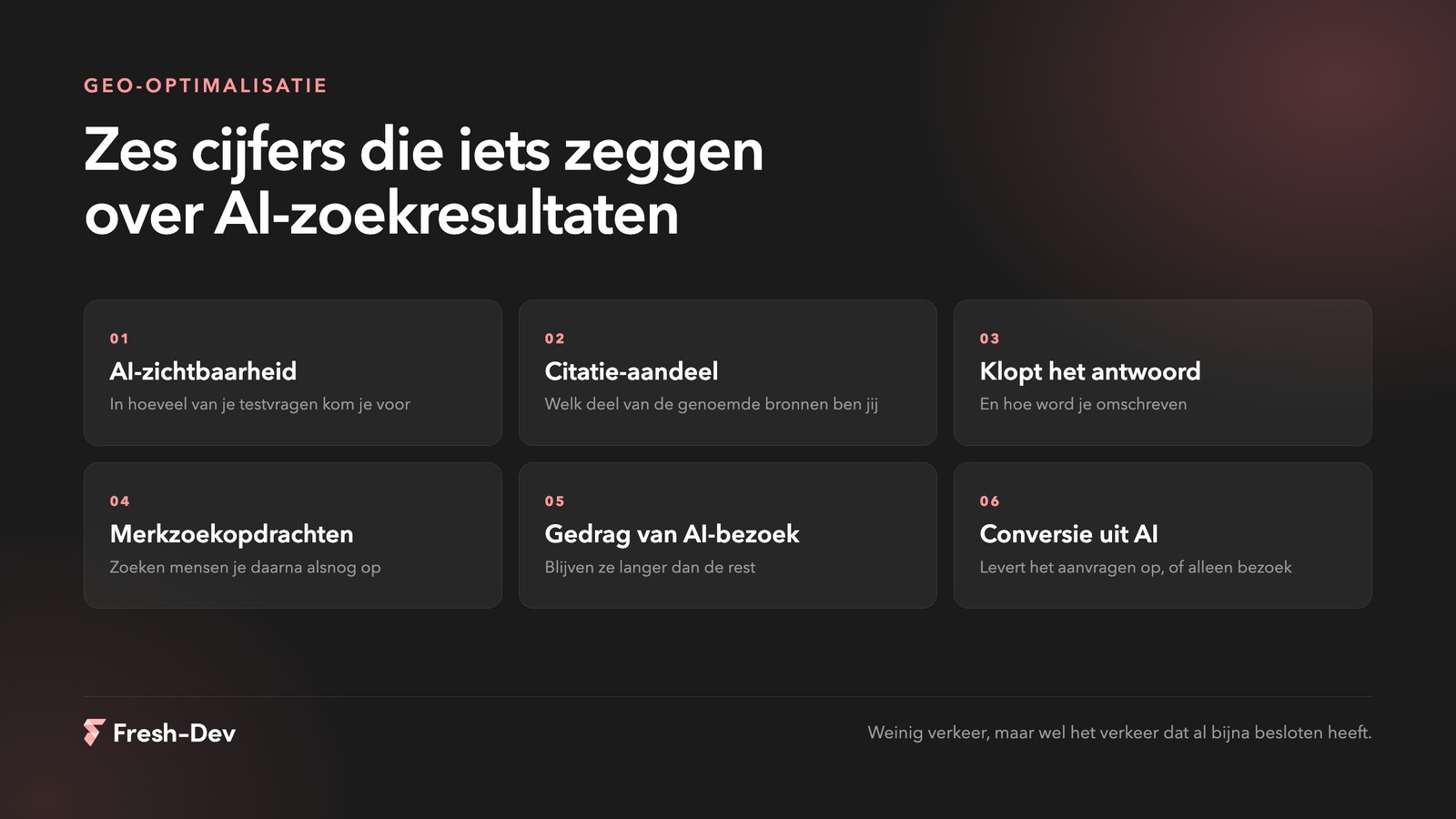
We keep track of these six for ourselves and for clients. The first three are about whether you appear at all, the last three about what it yields.
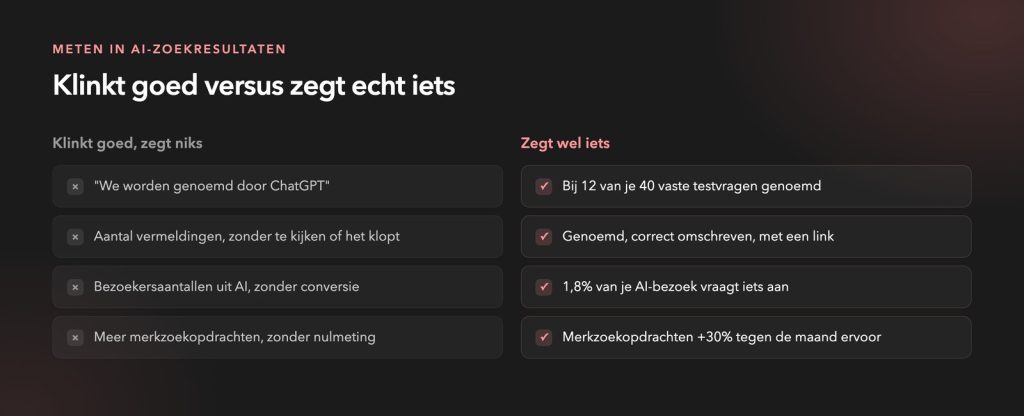
- AI visibility. Put a fixed list of questions to the assistants and count in how many of those answers you are mentioned. Twelve out of forty is a figure you can do something with, “we are mentioned” isn't.
- Share of voice. When you are mentioned, who else is listed there? Are you one of the three sources or one of the fifteen? That says more about your position than the number of mentions.
- Is it correct, and how does it sound. This requires manual work and it is the most important of the six. We are regularly mentioned with an outdated offering or a service that we do not do. Being mentioned with incorrect information is worse than not being mentioned.
- Brand searches. Someone reads your name in an answer and then looks you up anyway. In Search Console you can see that back as an increase in impressions for your own name. Compare month over month, and make sure you have a baseline figure.
- AI visit behaviour. Filter your visitors from ChatGPT, Perplexity and Gemini separately in GA4. Do they stay longer, do they view more pages? Usually they do, and then you know you are bringing in the right people.
- Conversion from AI. Ultimately the only one that matters. How many of those AI visits actually ask for something? With those small numbers, you can simply review it per request.