Have an application created for the web

Web application or customer portal Have made

A customer portal, a dashboard, or a connection between your systems. We build it in Laravel or WordPress, put it live, and then work on it further every month. The code and the data are yours.

From you

Code, data and accounts in your name

Every month

A noticeable improvement, even after live use

One must decide

AI does the groundwork; we decide

From day one

Monitoring and error messages during live operation

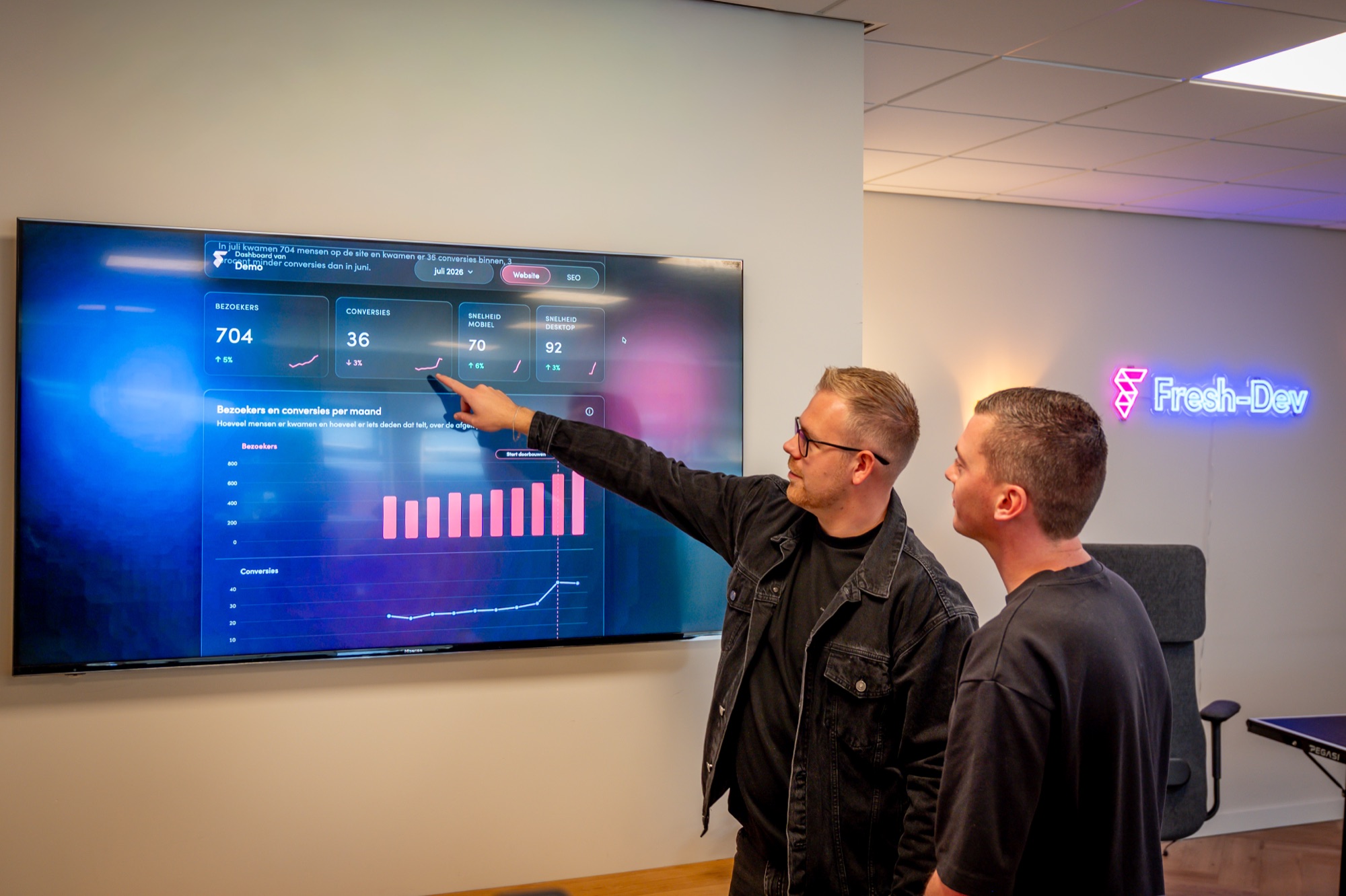
Jesse and Davey are looking at a dashboard at Fresh-Dev

A platform is never finished

With a website, you only notice that after a year. With a platform, often after just a month: users ask for an extra field, an export, a second role. That’s why after the launch we just keep working, with an improvement every month that you can point to. What you paid for must be yours. And you should always be able to leave.

Code, data, and accounts are yours from day one.

Every month an improvement that you can point out.

A roadmap and a changelog: you can see what has been done and what is coming.

If you want to continue with someone else, then you take everything with you.

You can always leave; the code and data are yours.

What we build

Three types of work are most common. Often, a piece of each of the three is included in a single project.

Customer portal

Have a customer portal created

A place where your customers log in and manage their own business: documents, invoices, status and appointments. Less email back and forth, and your customer doesn't have to call to ask how things are going.

What it can contain
  • Log in per customer, with rights per role
  • Log in with a one-time link, without a password
  • View and download invoices and documents
  • Link to your accounting system, CRM or webshop
  • Put on the home screen as an app
Dashboard

Have a dashboard made

Figures from your administration, planning or webshop on one screen, without anyone having to update an Excel spreadsheet every Monday. If Looker Studio or Power BI is enough for you, then we’ll say that too.

What it can contain
  • Data directly from systems Moneybird like your CRM
  • Sales, budgets, or progress per project in one overview
  • Only the numbers that your team uses
  • As a web app, without a license per user
Links

Have an API connection made

A connection between systems that now run independently. Orders that are entered into your accounting system, applications that are submitted with attachments in your recruitment system. This is how you automate business processes that are currently manual.

What it can contain
  • Links with Moneybird, among others, Mollie, WooCommerce and Gravity Forms
  • Error messages per connection, so that a malfunction does not go unnoticed for weeks
  • n8n for something simple, a separate link for criticism
  • Switching from Zapier or Make if costs or errors arise
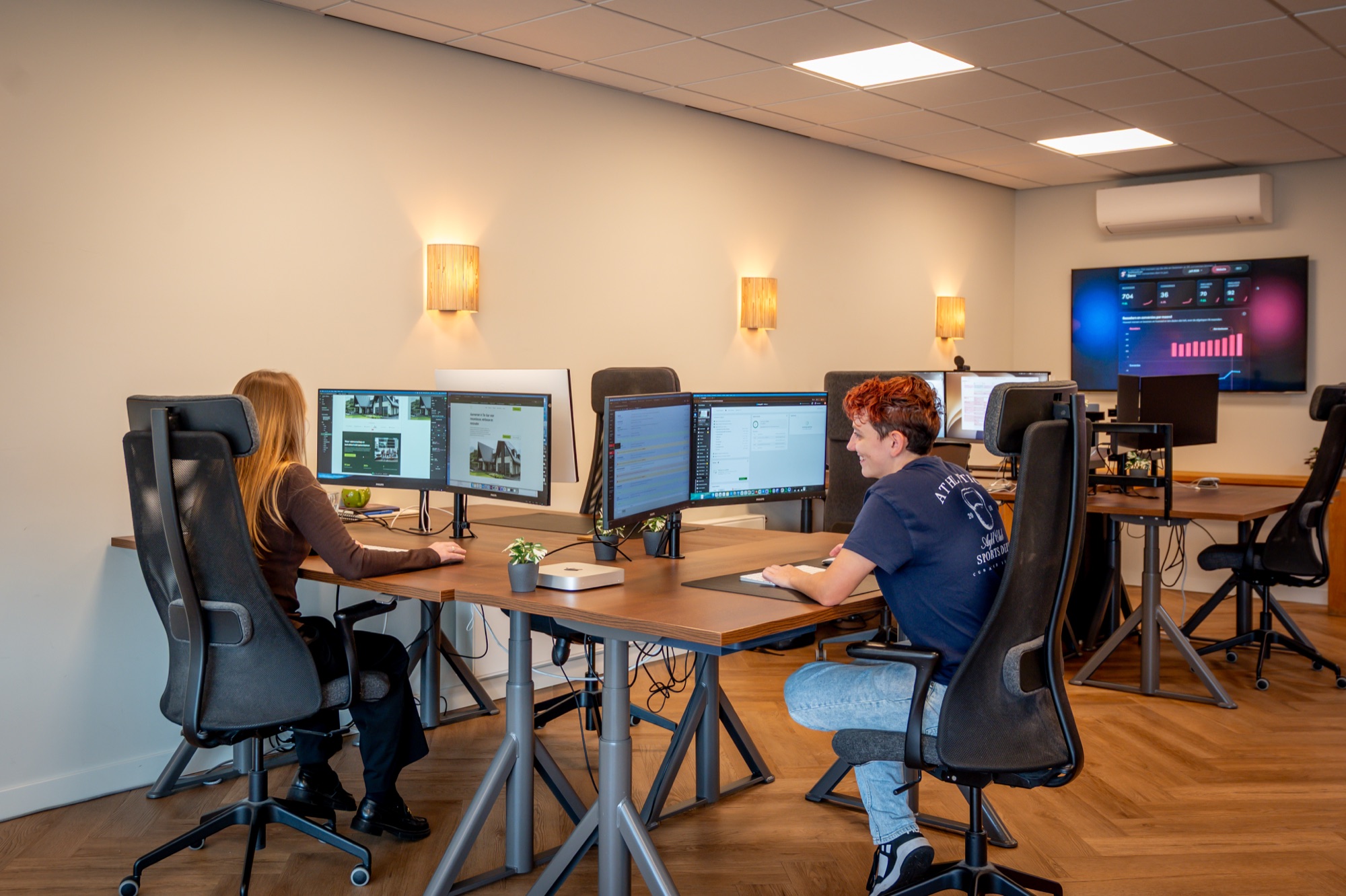
Colleagues Fresh-Dev at work in the office in Haarlem

Our own customer portal

Since October 2026, our customers have been logging in to customer.fresh-dev.nl. We built it the way we would build it for you. You can see per month and per day which hours have been created, what has been done, and what is coming up. Invoices are included as PDFs, with a payment link for what is still open, and the agreement on response times is also included.

If you put it on the home screen of your phone or iPad, it opens as an app. Your websites' status will be displayed next. Our own platform is also never out of date.

Log in without a password

An email link that works once and is valid for 15 minutes. After that, you remain logged in on that device for 30 days.

Hours and updates per day

You can see where the hours are spent, what has been done and what is coming next.

More of what we built

Most platform work is done behind a login and is not displayed on our work page. Therefore, it is listed here without names, but with some information about what it does.

A link between the website and the recruitment system

For an engineering firm, the vacancies come directly from OTYS, and open applications are sent back to OTYS with attachments. The old vacancy data has been transferred. The link has been coordinated with OTYS itself.

Our own company system

A Laravel application for CRM, projects, schedule board, hours, invoicing and capacity, linked Moneybird with HoorayHR. The system is still under development and has over 4,000 automated tests. In the same way, we build for clients.

Dashboard and monitoring for ourselves

Our business dashboard pulls data Moneybird from our planning system. It displays the sales figures alongside the forecast and shows VAT per quarter, cash flow, and project budgets. Interruptions are listed in status.fresh-dev.nl, and errors are logged per link on our own error reporting server.

An AI checker that anyone can use

On our AI checker Enter an address. You will receive twenty checks on how a language model reads your site, with a report on a separate page. A web application that runs publicly.

This is how we work

Start small, then continue every month thereafter

1

Discussion and price indication

We start with the process, not the technology. Who will be using it, what is happening with the manual process now, and which systems are already in place? After that, you will receive a price quote.

2

Design of the first version

Our design team designs the screens you need first. This way you can see what you're getting before there's a line of code.

3

Building and connecting

We build in Laravel or WordPress, depending on what is needed, and connect the related systems. In the meantime, you can take a look at a test environment.

4

Live, with monitoring from day one

During live trading, monitoring and error messages are displayed. The code, data, and accounts are in your name.

5

An improvement every month

After the live release, we continue to build at a steady pace: at least one improvement per month, more as the platform grows rapidly. You can see what has been done and what is coming in the roadmap and the changelog.

How much does it cost to have a web application created?

We do not quote our own rates. A platform with two screens and a platform with ten rolls differ in price in a multitude of ways. However, we do show what the market charges. This is the market bandwidth in November 2026, excl. VAT, based on prices published by Dutch agencies themselves.

API integration: usually €1,000 to €10,000

A simple one-way connection costs €1,000 to €3,000 on the market. With error handling and logging, that costs €3,000 to €10,000. If multiple critical systems need to be connected, the cost increases to €25,000 or more. Additionally, expect monthly costs for monitoring and minor adjustments. A tool like Zapier, Make, or n8n costs little at the start and then €20 to €100 per month thereafter.

Customer portal or web application: €7,500 to €50,000+

For a simple web application, agencies quote around €5,000. A simple customer portal starts at around €7,500. An average portal costs €20,000 to €50,000, while advanced platforms go even higher.

Dashboard: €960 to €8,000

A dashboard in Looker Studio costs €960 to €2,400 on the market, in Power BI €1,600 to €4,000 plus a license per user per month. A dashboard as a standalone web app, without licenses, costs around €3,200 to €8,000.

What you get from us

After one conversation, a price quote is provided. The amount in the quote is the amount on the invoice. After that, you pay monthly for the renewal, with an improvement that you can identify each month.

Sources market bandwidth: fruitcake.nl, artiqmotion.nl, scoreagency.nl (updated September 2026), onrustmedia.nl. These are not rates from Fresh-Dev.
Sometimes you don't need a web application

If an existing package does most of what you want, that is often the better choice. Then we link it to your website or your administration and build only what is missing. A custom platform pays off if your process works differently than that of your competitor, or if your license costs continue to rise per user. We say this in the first conversation. If a website with a few smart features is enough, check out website design.

Frequently asked questions about creating a web application

How much does it cost to have a web application or customer portal created?

In the market, a simple customer portal starts at around €7,500. On average, it costs €20,000 to €50,000, and goes up further. An API connection usually costs €1,000 to €10,000. This is the market range, excluding VAT, based on prices published by fruitcake.nl, artiqmotion.nl, scoreagency.nl, and onrustmedia.nl themselves. These are not rates from Fresh-Dev.

We do not quote hourly rates. After a conversation, you will receive a price estimate, and the amount in the quote is the amount on the invoice.

What is the difference between a website, a web application, and software?

A website shows information to everyone. With a web application, you do something: log in, enter data, follow an application, or run a report. Creating software is similar; as long as it runs in the browser, you need both. Often you need both; the web application runs alongside or behind your website.

How long does it take to create a customer portal?

Offices usually give 4 to 10 weeks for a first version. We don’t give a final delivery date as long as the first version isn’t finalized yet. We start with the screens you need first so you can get started with a working version quickly. Then we build on every month thereafter.

Can a web application be linked to my ERP, accounting system or webshop?

Usually, if the system has an API. We connect with Moneybird, among others, Mollie, WooCommerce, Gravity Forms and OTYS. If your system doesn’t have an API, we look at whether it can be done via exports or an intermediate step in n8n.

Can you set rights per user?

Yes. Per role you determine what someone sees and what they are allowed to do. A customer only sees their own data, an employee sees more and an administrator sees everything.

How secure are my customers’ data?

Everyone sees only what is relevant to their role. Logging in is done with a one-time link, like in our own customer portal, so that no passwords circulate. Errors and disruptions are detected through our own monitoring system.

If a platform processes personal data from your customers, the GDPR requires a processor agreement. This agreement specifies who processes which data, for what purpose, and how it is secured.

What happens when an API changes?

Then a connection may break. Therefore, every connection reports errors to us, usually before you notice it. The connection must then be adjusted to the new version of the API. How such work is scheduled is something that must be agreed upon in advance.

Zapier, Make of n8n, or a custom link?

For a simple step between two tools, a standard tool is often enough. It costs little at the start and then €20 to €100 per month thereafter. A custom integration is better if the process is critical, if it involves a lot of volume or if you need error handling and logging. We also use n8n ourselves, for our own site.

Can I expand the platform later?

That’s what it’s built for. A platform is never finished. After the live launch, we build one improvement every month, and we plan for larger expansions in the roadmap.

Is the code mine, and can I leave?

Yes. Your code, data, and accounts are yours from day one. If you want to continue with another agency or with your own developer, that’s fine. You can always leave.

Does my website need to be rebuilt for a link?

Usually not. A link can be placed on an existing site. If your site runs on something that makes that difficult, you’ll hear about it beforehand.

Where does the web application run and who manages it?

A web application can be run on its own server or with a hosting provider. Which is best depends on the requirements for speed, security, and management, as well as what is already running. Who performs the updates, monitoring, and tracking of error messages should be clearly defined in advance.

When is it better to use existing software?

If a package does most of what you want, and your process is not fundamentally different from others’, then we’ll link that package to your website or administration and build only what’s missing. A custom platform is worth it if your process is unique, if the volume is large, or if license costs per user continue to rise.

Tell me what's happening with the hand now.

Leave your details, and we’ll call you for a brief intake about the process and your systems. After that, you’ll receive a price quote and an initial idea of the approach.

Jesse Lafeber
Jesse Lafeber

Head of Development

Request a price quote

This field is for validation purposes and should be left unchanged.